Pearson Edexcel · GCSE · Psychology
Course version: 1PS0 · Version from Sept 2017
Understand, and know the difference between: a. primary data b. secondary…
Full specification wording
Data analysis: 11.2.4 Understand, and know the difference between: a. primary data b. secondary data
In psychological research, data is categorised by its source.
Checked against the Pearson Edexcel 1PS0 specification (opens in a new tab) on .
- Point 4 of 5
- 2 key terms
Study notes
From the checked teaching notes for this specification point.
The idea
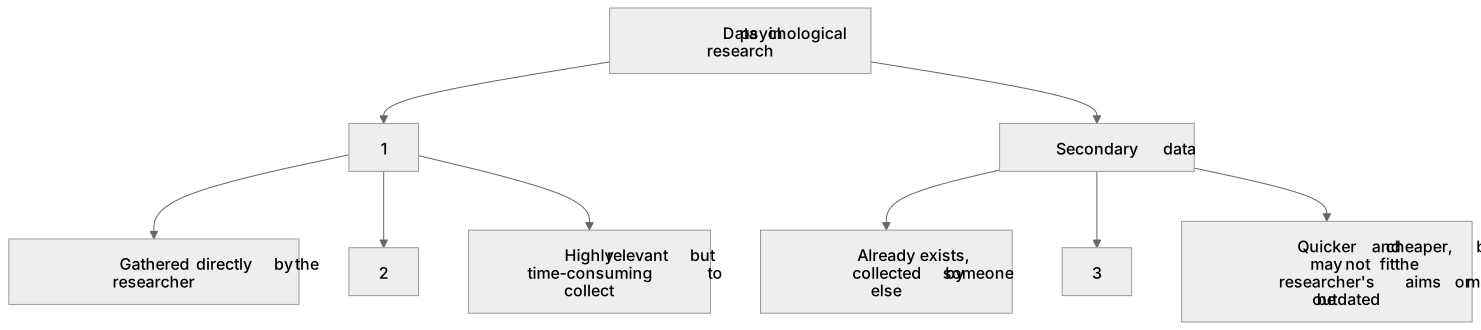
In psychological research, data is categorised by its source. Primary data is gathered directly by the researcher specifically for their current investigation. For example, if a psychologist conducts a new memory experiment and records participants' scores, this is primary data. It is highly relevant but time-consuming to collect. Secondary data is information that already exists, collected by someone else for a different purpose, such as government statistics or previous journal articles. While secondary data is quicker and cheaper to access, it may not perfectly fit the researcher's specific aims or might be outdated. Understanding this distinction is crucial for evaluating the validity and practical constraints of a study's methodology.
What earns the marks
- Defining primary data as first-hand information collected specifically for the research aim.
- Defining secondary data as pre-existing information collected by others for a different purpose.
- Identifying examples of primary data, such as questionnaire responses gathered by the researcher.
- Identifying examples of secondary data, such as official statistics or meta-analysis data.
- Comparing the two types based on time, cost, or relevance to the research question.
Common mistakes and how to put them right
Believing that primary data is always more valid than secondary data.
Put it right: Recognise that primary data can also be flawed by researcher bias or poor design, while secondary data can be highly rigorous.
Confusing primary data with qualitative data.
Put it right: Primary data refers to the source (first-hand), and it can be either qualitative (interviews) or quantitative (test scores).
Stating that secondary data is just 'old' data.
Put it right: Define secondary data as data collected by someone else for a different purpose, regardless of its age.
Exam tips
- When evaluating a study, use the terms primary and secondary data to discuss the time and cost efficiency of the research method.
- If asked to identify the data type in a scenario, look for clues about who collected the data and why it was originally gathered.
- Be prepared to explain one advantage and one disadvantage of using secondary data compared to primary data.
Try the lesson
The start of the Data analysis: 11.2.4 Understand, and know the difference between: a. primary data b. secondary data lesson, made from checked teaching notes for this specification point.
Have a go first
Which of the following statements provides the most accurate definition of primary data in psychological research?
Listen
In psychological research, data is categorised by its source. Primary data is gathered directly by the researcher specifically for their current investigation. For example, if a psychologist conducts a new memory experiment and records participants' scores, this is primary data. It is highly relevant but time-consuming to collect. Secondary data is information that already exists, collected by someone else for a different purpose, such as government statistics or previous journal articles. While secondary data is quicker and cheaper to access, it may not perfectly fit the researcher's specific aims or might be outdated. Understanding this distinction is crucial for evaluating the validity and practical constraints of a study's methodology. A strong answer earns marks for these points. Defining primary data as first-hand information collected specifically for the research aim. Defining secondary data as pre-existing information collected by others for a different purpose. Identifying examples of primary data, such as questionnaire responses gathered by the researcher. Identifying examples of secondary data, such as official statistics or meta-analysis data. A common slip: Believing that primary data is always more valid than secondary data. Instead, recognise that primary data can also be flawed by researcher bias or poor design, while secondary data can be highly rigorous. Exam tip: When evaluating a study, use the terms primary and secondary data to discuss the time and cost efficiency of the research method.
See it

Key words
Say what each word means before you turn the card.
Primary data
Try answering aloud or in your head before turning the card.
Secondary data
Try answering aloud or in your head before turning the card.
See every definition
- Primary data
- First-hand information gathered directly by the researcher specifically for their current investigation.
- Secondary data
- Pre-existing information collected by someone else for a different purpose, such as government statistics or previous journal articles.
Label the diagram
Some boxes have lost their names. Pick the right name for each number.
1Box 1
2Box 2
3Box 3
There is more to this lesson
The full lesson goes on to check your understanding and help you earn the marks. Create a free account to carry on, with your progress saved.
A week of Premium from your first lesson · Then the free plan continues · No card, no charge
Test your understanding of Data analysis: 11.2.4 Understand, and know the difference between: a. primary data b. secondary data
Active recall beats re-reading. Take an instant quiz now to test what you’ve learned and lock it into long-term memory.
A week of Premium from your first lesson · Then the free plan continues · No card, no charge